
Why Does My Roof Leak Only in Heavy Rain?
Quick answer: if a roof leaks only during heavy or wind-driven rain, the defect is often at a junction rather than across the whole roof. Common causes include tired chimney flashing, blocked or damaged valleys, lifted tiles, failing verge or ridge details, overflowing gutters, and flat-roof upstands that only fail when water volume rises.
Reviewed: August 2026. Cost figures are broad UK guide ranges only; access, roof type, extent of damage and scaffolding can change the final quote substantially.
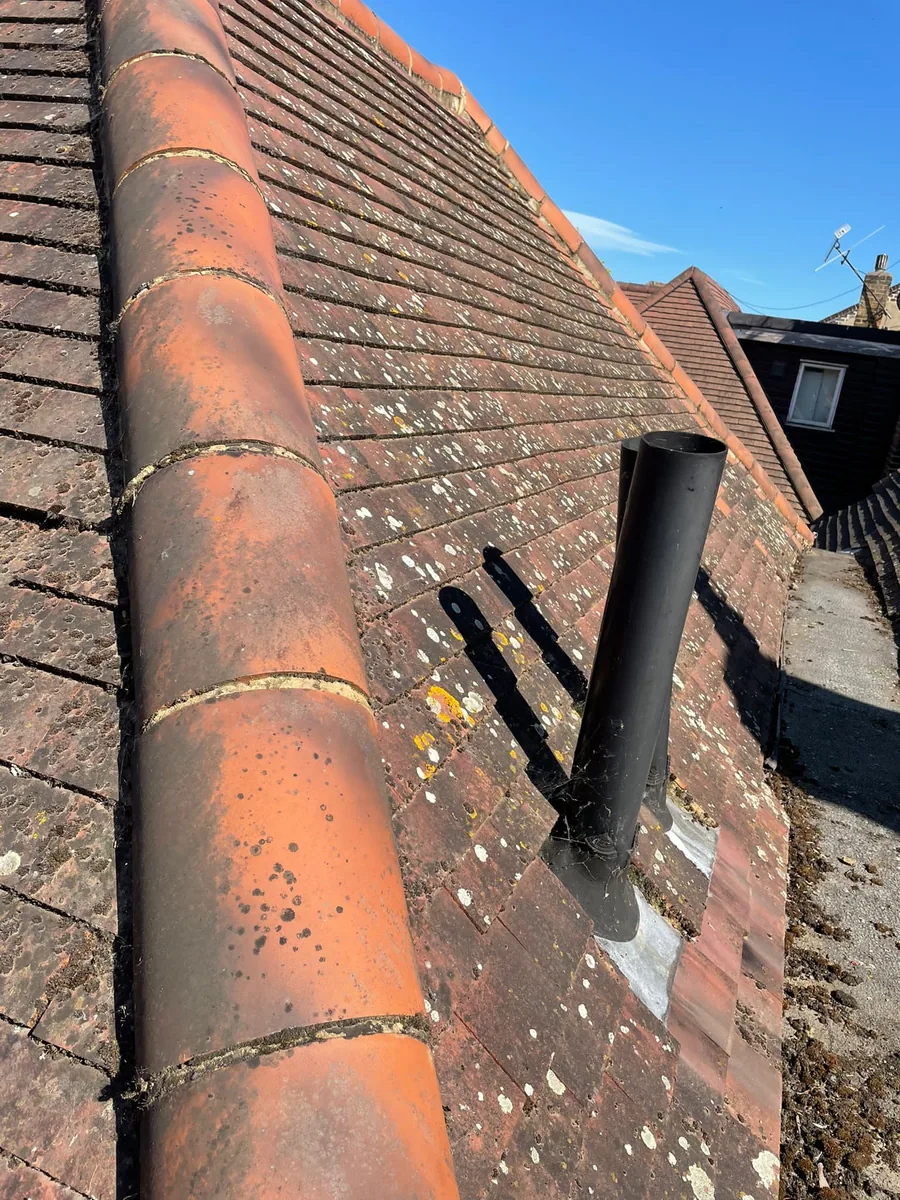
A roof that stays dry in light rain but leaks in a downpour is giving useful diagnostic information. Higher water volume and wind pressure expose small defects that ordinary rain may never reach.
The most common causes of a roof leak in heavy rain
Wind-driven rain around chimneys and walls
Rain does not always fall vertically. Strong wind can push water sideways and uphill into small gaps at lead flashing, soakers, chimney back gutters and roof-to-wall abutments. If the leak appears on the windward side of a chimney or only during storms, flashing is one of the first details worth checking.
Roof valleys that cannot clear water quickly enough
Valleys carry a concentrated flow from two roof slopes. Moss, leaf debris, cracked mortar, split lead or a damaged GRP valley can cope in light rain and then overflow or track sideways in a cloudburst. See our roof valley leak and repair cost guide.
Slipped or cracked tiles
A slightly displaced tile may still shed gentle rain. In stronger wind, water can be driven beneath the overlap and onto the underlay. Older concrete and clay roofs can also have tired battens or underlay beneath apparently minor tile movement.
Gutters and outlets backing up
Blocked gutters, undersized outlets or sagging runs can overflow back toward the fascia and eaves. That can look like a roof leak even though the covering itself is sound. Our fascias, soffits and guttering service covers roofline drainage problems.
Flat-roof outlets, laps and upstands
On flat roofs, heavy rain can reveal poor falls, ponding, split membranes, weak edge trims or badly detailed upstands. Repeated patching is rarely the right answer when the membrane or deck has broadly failed.
What to note before the roofer arrives
You can make leak tracing much easier without climbing onto the roof. Note which room and wall the water appears near, whether it starts immediately or after prolonged rain, which direction the wind was blowing, and whether the leak stops as soon as the rain eases. Photos of the interior stain and safe ground-level photos of the roof are useful.
Do not climb onto a wet roof. Water often travels along rafters or felt before it becomes visible, so the damp patch inside is not necessarily directly below the entry point.
When a heavy-rain leak needs urgent attention
Arrange prompt assessment if water is close to electrics, ceilings are bulging, insulation is saturated, tiles or ridge sections are loose, or the leak is getting worse with each storm. For active weather damage see our emergency roof repair service.
Heavy-rain roof leaks in Surrey and London
Across Surrey and London, the roofs we are most careful with are those that combine older tiles, chimneys, valleys, extensions and mature-tree debris. Areas such as Guildford, Epsom and Richmond include many properties where the leak route is a junction detail rather than a simple missing tile.
Frequently asked questions
Is it normal for a roof to leak only in very heavy rain?
No. A sound roof should cope with heavy rain. A leak that appears only in downpours usually means a small defect is being overwhelmed by extra water volume or wind pressure.
Why does my roof leak when it is windy and raining?
Wind-driven rain can be pushed sideways beneath loose tiles and into weak chimney flashing, wall abutments, ridge details or other junctions that stay dry in calm rain.
Can blocked gutters make it look as though the roof is leaking?
Yes. An overflowing or sagging gutter can push water back toward the eaves, fascia and soffit, creating damp that is easily mistaken for a defect higher up the roof.
Should I use roof sealant to stop a storm leak?
Sealant can sometimes be part of a correctly specified detail, but smearing sealant over an unidentified leak often hides the cause and fails again. The leak route should be diagnosed first.