
EPDM vs GRP Flat Roof — Which Is the Better Choice?
If you are researching flat roof replacement options, you will quickly encounter two systems: EPDM rubber roofing and GRP fibreglass. Both are solid long-life alternatives to the old felt systems that most problem flat roofs were built with. Here is an honest comparison of the two so you can make an informed decision — or have a more informed conversation with a roofer.
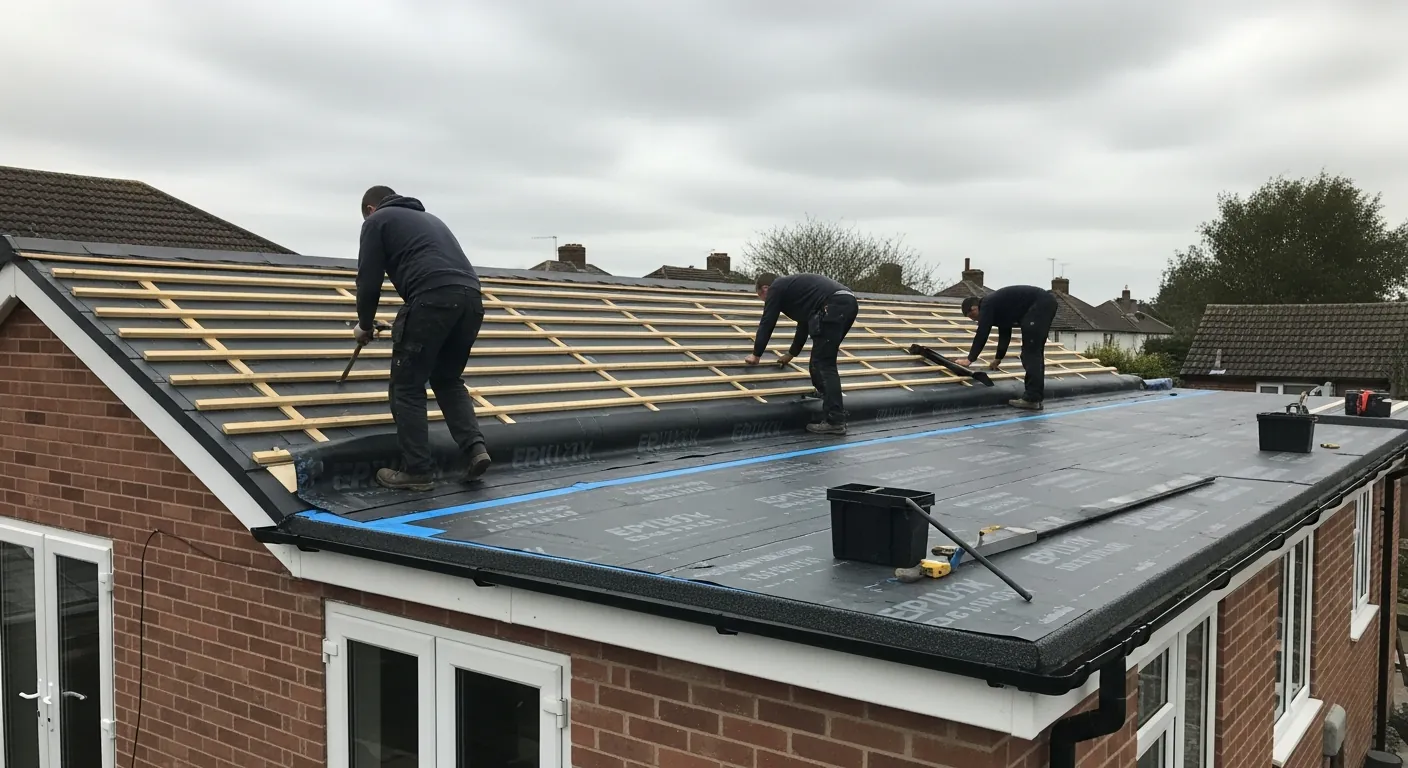
What is EPDM roofing?
EPDM stands for Ethylene Propylene Diene Monomer — a synthetic rubber membrane that has been used in commercial flat roofing for decades and has become increasingly popular in residential flat roof replacement over the past 20 years. It is manufactured in large sheets and bonded to a flat roof deck using adhesive.
The key characteristic of EPDM is its flexibility. The membrane can accommodate movement in the roof substrate without cracking, it handles UV exposure well, and it remains pliable in cold temperatures without becoming brittle. EPDM systems in the UK are typically either black or dark grey in colour.
Typical applications: Garage roofs, house extensions, bay window roofs, garden rooms, dormer flat tops, and larger flat roof sections on residential properties.
What is GRP fibreglass roofing?
GRP stands for Glass Reinforced Plastic — better known as fibreglass. In flat roofing, GRP is applied by laminating layers of glass-fibre matting with polyester resin directly onto the roof deck, creating a rigid, seamless, waterproof shell that is then finished with a coloured topcoat (usually grey or green).
GRP has been used in marine and industrial applications for many decades and was adopted for residential roofing in the UK in the 1990s. It is well-suited to complex profiles and shapes because it can be formed around upstands, gutters, outlets and unusual geometries without the need to cut and join separate sections.
Typical applications: Extensions with complex profiles, roofs with multiple upstands and abutments, bay roofs with raised edges, and any flat roof where a rigid, hard-wearing finish is preferred.
EPDM vs GRP — the key differences
Flexibility and movement
EPDM wins here. The rubber membrane is inherently flexible and tolerates movement in the deck below — whether from seasonal thermal expansion, structural settlement, or moisture cycling in timber substrates. GRP is rigid and can develop stress cracks if the deck it is laminated to moves significantly. For this reason, a GRP flat roof usually requires a more stable, better-specified deck (typically 18mm or 22mm exterior-grade plywood) to perform well long-term.
Handling irregular shapes and details
GRP wins here. Because it is applied in liquid form and hardens in place, GRP can be laminated seamlessly around upstands, outlets, pipe penetrations, and changes in level without cutting and bonding separate pieces of membrane. EPDM is flexible enough to work around many details, but complex profiles can require more skill and careful execution to keep fully bonded and watertight.
Appearance
GRP wins for appearance. The coloured topcoat gives a clean, hard finish that looks similar to a painted concrete surface. It ages well visually and does not wrinkle or develop surface texture over time. EPDM's black rubber surface is functional but less refined-looking, which may matter on a roof visible from a window or neighbouring property. Some EPDM systems are available in lighter colours for reduced heat absorption, but the material always has a characteristically rubber-like look.
Repairability in the field
EPDM wins here. EPDM repairs are typically made using bonded EPDM patch kits — relatively simple to apply and usually invisible once complete. GRP repairs require relaminating over the damaged area and applying a matching topcoat; while effective, they are more material and skill-intensive and the repair can sometimes be visible as a slight colour variation in the finished surface.
Lifespan
Both systems are rated to last 25–50 years when correctly installed. Some EPDM products carry manufacturer warranties of 50 years. In practice, both outlast the old built-up felt and bitumen systems they typically replace, which rarely performed beyond 10–15 years.
Lifespan in practice depends heavily on installation quality. A poorly installed EPDM roof or a GRP roof laminated over a damp or unsupported deck will fail prematurely regardless of the membrane type.
Cost comparison
For straightforward flat roofs without many upstands or complex details, EPDM and GRP are broadly comparable in cost. On more complex roofs, GRP may be slightly more expensive due to the extra material and labour required to laminate around details. On very large, simple areas, EPDM may be slightly more economical to install.
As a rough guide for 2025:
- Standard garage roof (approx 20–25m²): £1,500–£3,000 for either system
- Extension flat roof (approx 15–30m²): £1,800–£4,000 depending on detail complexity
- Bay window roof (approx 3–6m²): £600–£1,400
These are rough guide figures only — the actual cost depends on deck condition, access, upstand height, the number of penetrations, and whether the existing deck needs to be replaced.
Warm roof vs cold roof — the question that matters more than EPDM vs GRP
Before deciding between EPDM and GRP, it is worth understanding the more important decision: warm roof vs cold roof construction.
An old flat roof is typically built as a cold roof — the insulation sits below the deck, inside the property. Cold roofs are prone to condensation and interstitial moisture problems. A warm roof puts the insulation above the deck, under the waterproof membrane. This eliminates the condensation risk and significantly improves thermal performance.
Both EPDM and GRP can be used as the waterproof membrane on a warm roof construction. If you are replacing a failing flat roof, this is the ideal time to upgrade to warm roof construction — the additional cost is relatively modest compared to the total project cost and the performance benefits are significant.
Which does Never Felt Better recommend?
We work with both systems and recommend the most appropriate one for each specific roof. In general:
- For straightforward garage roofs, simple extension roofs, and dormer flat tops where appearance is less critical: EPDM is often the better choice — long-established, flexible, easy to repair, and well-priced
- For complex roof shapes, lots of upstands and abutments, or roofs where appearance matters (visible from windows or neighbouring properties): GRP is typically the better fit
- For all flat roof replacements: we recommend warm roof construction wherever structurally feasible
The right answer for your roof depends on the specific geometry, what the existing deck is made of, how the roof drains, what access is like, and what the surrounding details look like. We survey before recommending and quote with a clear written specification so you know exactly what system is being installed and why.
When to replace rather than repair a flat roof
If your existing flat roof is leaking, the first question is whether it can be repaired or whether flat roof replacement is more appropriate. Repair makes sense when the membrane is largely intact and the fault is isolated. Replacement is usually the right decision when:
- The felt or membrane has failed in multiple places, or is blistering or delaminating across a large area
- The deck below is damp, soft or deteriorated and needs replacing anyway
- The roof is more than 15–20 years old and has already had one or more repairs
- The roof is a cold roof construction and persistent condensation is causing problems
Repeated repair of a failing flat roof almost always costs more than a properly specified replacement. Once the deck is wet and the membrane has started to fail, each patch extends the problem rather than solving it.
Ready to discuss your flat roof?
We cover flat roof replacement across Surrey and London for residential properties where the job needs doing properly. Minimum job value £1,000. We provide a written quote based on a survey of your specific roof, not a phone estimate.
More flat roofing guides
These pages cover flat roofing and related topics in more depth: